Sunday, September 12, 2010

Tracking Bears in Western Virginia

Dan writes:

I spent Labor Day weekend camping with friends at a PATC cabin outside
Shenandoah National Park in western Virginia. The cabin logbook had
many reports of black bear sightings on the roads and trails around the
area. I spent some time exploring the trails around the cabin, and was
able to photograph several types of bear sign. Once I figured out the
food preferences of the local bears, and their marking habits, it became
fairly easy to predict where to look for sign.

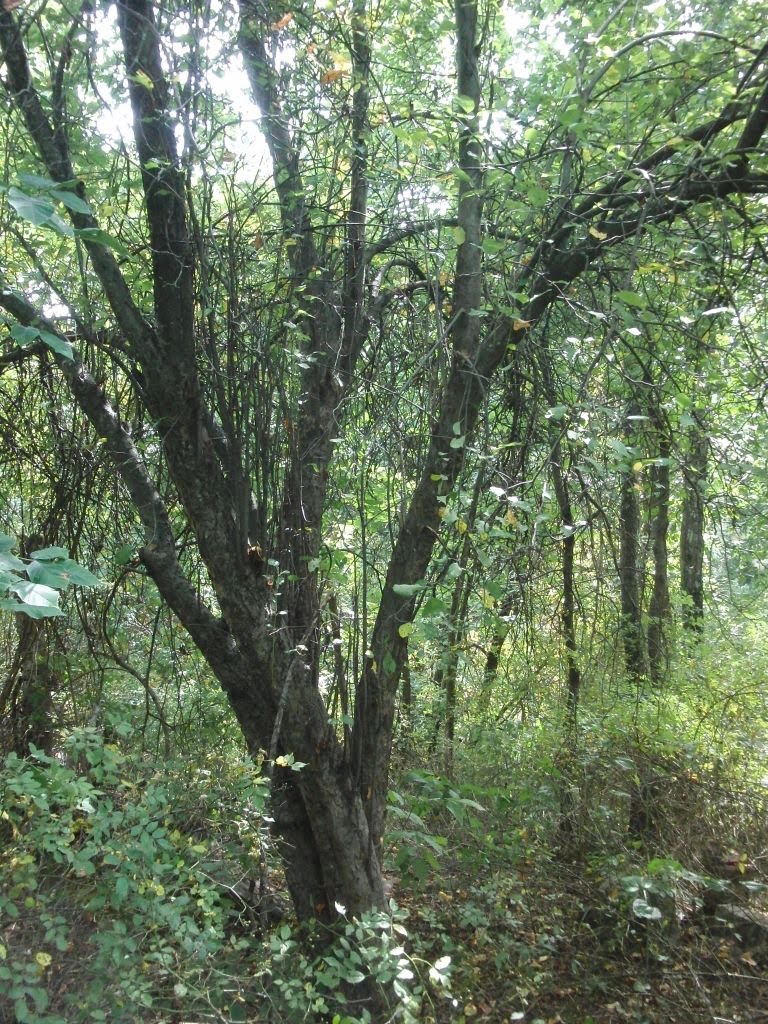
All apple trees showed climbing scars and broken branches. I never
found a classic "bear nest", but did find apple and black cherry trees
with broken limbs that had been bent back toward the center of the crown.


Cedars along the trail were usually swiped and showed diagonal claw marks.


Bear scat consisted of black cherry seeds, or a smaller seed from a
fruit I was not able to identify.


Painted wooden sign posts on trails away from the cabins were massively
scarred with significant bite marks - I found cheek hair on several of
these posts. In one photo, I've placed sticks into the dot-dash pattern
caused by the bear's canine teeth (thanks, Sue Morse!)


Smaller diameter trees (3-5" diameter) with painted blazes usually
showed an old bite mark directly on the painted blaze. It took a while
to notice this pattern, but once I started looking for it, EVERY blazed
tree of a certain diameter had an old bite scar right on the blaze.

I examined many mature beech trees, and never found climb marks. I
found one old black cherry that had been climbed, and a mature maple
that showed clear climb marks all the way up the trunk.


Based on the sign I observed, I'll concentrate my future bear tracking
on fruit trees (apple and cherry), on easily-markable cedar, and on
human markings (sign posts and blazed saplings) along the trail.

Thursday, August 26, 2010

Tropical Track

...For anyone who cares to do a bit of research and take a stab at what
this is.

A Threever of Beaver or a Romp of Otter?

Dan writes:
We recently learned that three raccoons is called a gaze or nursery. So
what do you call three beaver? I propose that this be called a threever
of beaver.

My initial reaction when I saw this photo on my camera's screen was that
I was seeing otter. The animal in the rear has that sleek otter form.
But the heads look more like beaver, and the lead tail looks flat and
hairless.

I've never seen beaver slinking along all flattened down like this. It
looks like #2 went under the log, while his friend decided to go over
the top. In the second photo, you can see a new wet spot on the log -
was there a fourth member of the party?

I didn't notice it until now, but the second photo (taken 50 seconds
later) also shows two glistening piles (one in dead center, the other by
the pinecone in lower left). What's up with that?

Sadly, I had another camera aimed at this spot, but it triggered off the
water (to the right of these photos) and filled its card by the second day.

Let's hear some opinions. What's going on in these photos?

Raccoons emerging from Elizabeth Brook, Stow, Delaney WMA

Dan's camera trap captured these raccoons foraging along the bank of
Elizabeth Brook at the Delaney WMA in Stow, MA. This is the same
"Beaver Crossing" location where I photographed beaver and otter last
winter:
http://nashaway.blogspot.com/2009/11/beaver-crossing-photos.html
http://nashaway.blogspot.com/2009/12/beaver-at-work.html
http://nashaway.blogspot.com/2009/12/otter.html

Raccoons made appearances every four nights, always between 9PM and
midnight.

Monday, August 23, 2010

Walkingstick

Saw this critter on my back door the other day and took a few photos. Check out its head; it looks like blades of grass. And its butt ... what's that all about? Even after some research, I'm not sure exactly what kind of walkingstick this is. Anyone?

Thursday, August 19, 2010

A Gaze of Raccoons

Dan writes:
I set up my remote camera to gaze upon the base of these large white
pines at the edge of a wetland. I often find a raccoon latrine on the
side of the tree facing away from the water, and that was the case here.

In the early dawn of August 13th, this gaze of four raccoons happened
along. Other visitors included a neighborhood dog (who marked in front
of the tree), a fisher, a groundhog, and a "green bandit". (That's a
raccoon who has recently foraged in the duckweed-infested wetlands.)

According to the all-knowing Internet, a group of raccoons is called a
gaze or nursery. Given the banded tails and masks, I would have called
them a band.

Thursday, August 12, 2010

Introducing PerchCam!

Dan writes:

Since there's not much wildlife tracking going on this summer, I thought
I'd share some photos from a project I started working on last winter.
PerchCam is an attempt to turn my Canon DSLR into a really high-quality,
really expensive wildlife camera. I've turned a motion detector into a
remote shutter switch for my Canon Digital Rebel, and attached it to a
40 ft wire. That lets me back up far enough to shoot through a
300-500mm lens to capture the bird against a nice background. I hide
the motion sensor on a perch, branch, or stump near my backyard bird
feeder. Any time a bird or squirrel trips the sensor, the camera takes
a picture. (Unfortunately, the camera also takes a picture any time the
wind blows, or a butterfly sneezes...)

I used the system a number of times in January and February of 2010, and
then abandoned the project until recently. I'm working on some new
improvements, but at the moment the problem is mainly a lack of birds!

Enjoy the photos! I've finally gotten around to putting out my other
wildlife cameras, so hopefully I'll have some mammals to share in the
next month.

- Dan

p.s. Don't forget to mark your calendars for the 3rd annual Mass/NE
Wildlife Trackers' Conference, Oct 30, 2010!
http://northeastwildlifetrackers.org/