Saturday, June 4, 2011

Phoebe and Freeloader

Janet was snooping around in central MA this morning, and discovered
this nest plastered to the wall of a cliff. This was well of the beaten
path, and the cliff wall faced a large wetland. As you can see, the
outer part of the nest is made of moss and other fibers, and lined with
fine grasses. I believe the nest and white eggs belong to an eastern
phoebe, and the speckled ones were left by a brown-headed cowbird.

Phoebes often build their nests on human made structures: under bridges,
on rafters, trestles, etc. Natural sites like you see here have become
fairly uncommon, according to what I read, so I was excited to find it.

I've also learned that, like this one has been, phoebe nests are heavily
parasitized by brown-headed cowbirds, and the phoebes often dessert the
nest and begin anew, when they discover those big speckled eggs.
However, these eggs were quite warm, so I think someone has been setting
on them. I must have frightened her away without realizing it.

Wednesday, May 25, 2011

Minima maxima sunt

...Or maybe it's parva leves capiunt animas.

Anyway, Tetracis cachexiata on Cypripedium acaule.


Monday, May 23, 2011

Bark and Blossoms

Janet writes: These photos are from a recent family hike up to a
ridgetop black gum swamp in southern Vermont. In the top photo you are
looking at the thick, furrowed bark of a mature black gum (tupelo)
tree. I'm guessing maybe 200 yrs old (?). A younger specimen would not
have such deep furrows. An older specimen (around 400 yrs) might have
smoother bark in this climate, because exposure to snow and freezing and
thawing over the years causes the blocks of bark to fall off. This
tree's diameter is not that large, probably because the conditions on a
New England ridgetop are rather harsh for a black gum, which prefers the
warm swamps of the southeastern US. Yet, it is the dominant tree
species in this high elevation VT swamp. How to explain that?

The wood of black gums is so light weight (partly because they hollow
with age), and brittle, that trees usually loose just their tops when
subject to severe winds, as ridge top trees often are. The tree remains
alive and can sprout, and vigorously sprout they do. Most other trees
have heavier wood, and in an exposed setting like this, will topple and
die when hit by severe wind, because the roots come up out of the ground
as the tree falls. So, in this environment, a black gum has a
competitive advantage over other species.

So how did this southeastern species get to Vermont? It was common in
the northeast during the "Holocene Thermal Maximum" of 5,000-9,000 year
ago, but its range receded southward as the climate cooled, leaving, in
Vermont, only remnant populations on ridgetop swamps where they could
out-compete other species.

Painted trillium graced the humusy, acidic floor of the swamp when we
visited several weeks ago.

Thursday, May 19, 2011

Venison anyone?


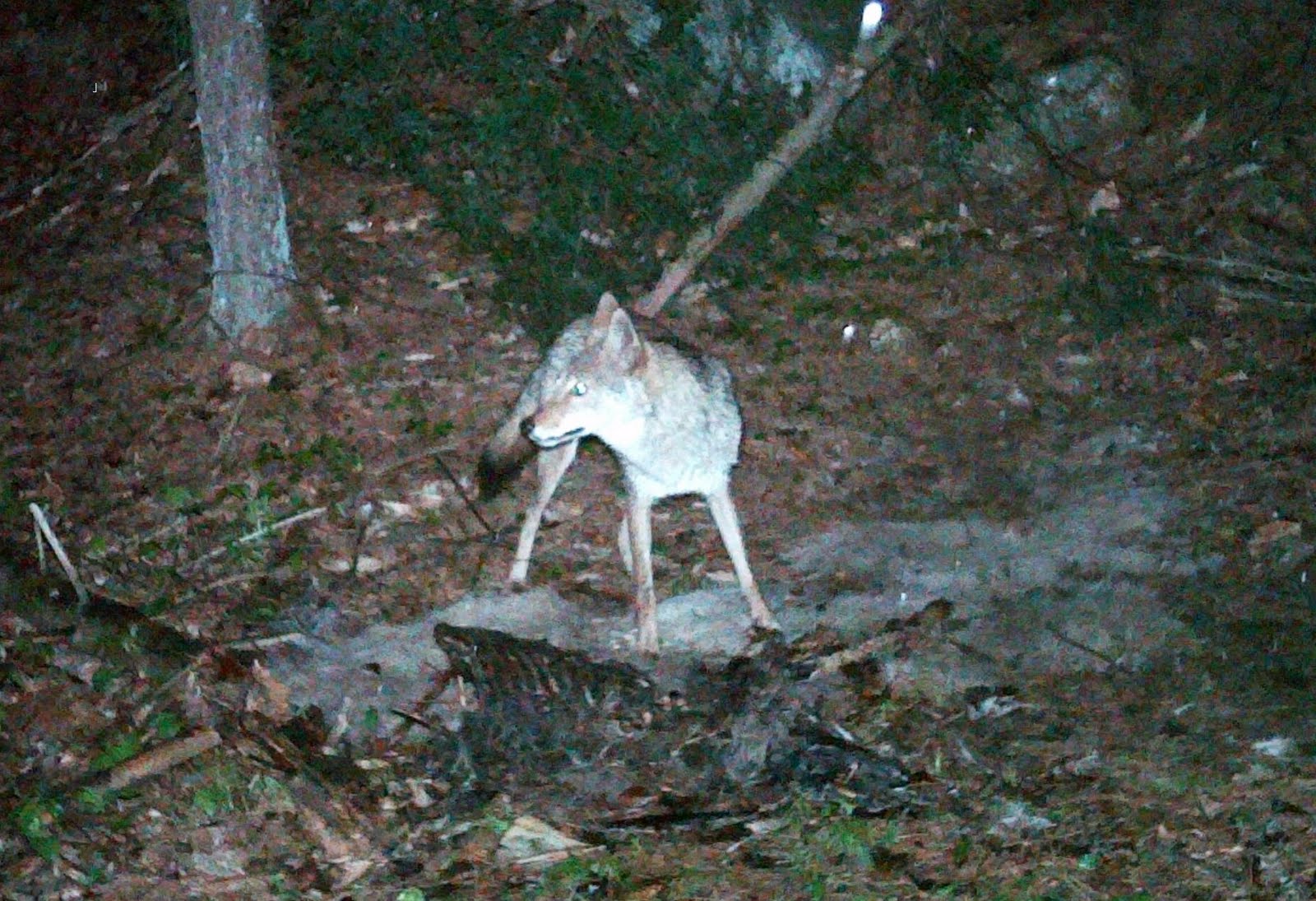
I've had my cameras positioned over a deer carcass for several weeks. For the first half of that time, there was almost no action. Fox, fisher and a hawk came by to take a look, but didn't "dig in." Crows made an attempt, but apparently didn't have the ability to penetrate the hide. It was only after a neighborhood dog finally started working on the very-aged carcass that vultures and, ultimately, coyotes started coming by to snack.

Thursday, March 17, 2011

Diving Ducks and more


Lars reports - Spring is here in 3 days. The ice is just beginning to open, and here come the visitors. Beginning earlier this week, I began seeing lots of migratory, Arctic and local ducks on the northern section of Delaney Complex (Harvard/Stow/Bolton). Over the last few days, I have seen perhaps thirty hooded mergansers, a few Common Goldeneyes, some Buffleheads, 5 - 10 pairs of Wood Ducks, and a mating pair of Mute Swans. That doesn't even include all the mallards and Canada Geese.

This is the best spot that I know of where one can predictably see so many things in such a small area. It is shown in the map above. I think that the reason is that the current turns a sharp corner at that spot. Therefore, it is the first place for the ice to open. And so they come, looking for a meal. Last year at this time I also saw a loon on two occasions. This morning, I was almost run over by an inattentive muskrat while watching the ducks.

One trail head begins on Finn Rd just west of the Stow/Harvard line and a line of 4-5 houses. The other, shorter trail begins off of Taylor Rd Stow, at a parking lot near some newly built houses. If you take the short path, take rubber boots (partly flooded as of yest PM). If you take the long way (prettier, dry), take a right at the only fork there is. It will take you out onto the top of the short esker which leads out onto the point and the loop trail. The open water between those two trails (at the star) is where you'll see all the action.

So, it's a guarantee that if you go in the next week or so (before the ice opens too much), you'll see this great concentration of ducks. Bring binoculars, leave the dog at home, and approach slowly or the Canada Geese will scream at you.

The photo is from "Birds of America," Doubleday, published 1917, and the authors describe the hooded merganser as having "an unpalatable fishy flavor." The map is from Google Maps.

Monday, March 14, 2011

Thursday, March 3, 2011

RIP Eastern Cougar

The US Fish and Wildlife Service has officially declared the eastern
cougar to be extinct in US and Canada. Strangely, the Canadians
recently came to the opposite conclusion!

http://www.montrealgazette.com/technology/officials+declare+eastern+cougar+extinct+despite+sightings+Canada/4374167/story.html