Wednesday, July 6, 2011

Toxic Newts and Dwarf Pitch Pines


Lars spent the weekend in the Berkshires in Western Mass, in Mt Washington State Park. We went to see Bash Bish Falls and on the way down the trail found an immature Eastern Newt (both pictured above). From a USGS website:

The Eastern Newt, Notophthalmus viridescens, and its close relative the Striped Newt, N. perstriatus are unique in that they undergo two metamorphoses. The first is the usual transformation from aquatic, gilled larva to an air-breathing terrestrial form. However in these two species there is a second, less striking metamorphosis to a breeding aquatic adult. The sexually immature land phase is usually called an Eft. The Eft stage may last anywhere from 1-7 years. The skin of the Eft is toxic and their bright coloration serves as a warning - it is not so rare to find an Eft wandering about in broad daylight after rain.


It was in broad daylight in the rain. Good thing I didn't touch (or eat) it.


Then off to nearby Mt. Everett at 2,600 ft to find a community of dwarf pitch pines. This is a rare example of this type of old growth forest in New England. By core sampling studies, these trees range from 12 to 170 years old, despite most being less than 3 meters high. Other mixed, dwarfed hardwoods include Red Oak, Red Maple and Birch. What a beautiful place! It's a natural bonsai garden on the Appalachian Trail.

Monday, July 4, 2011

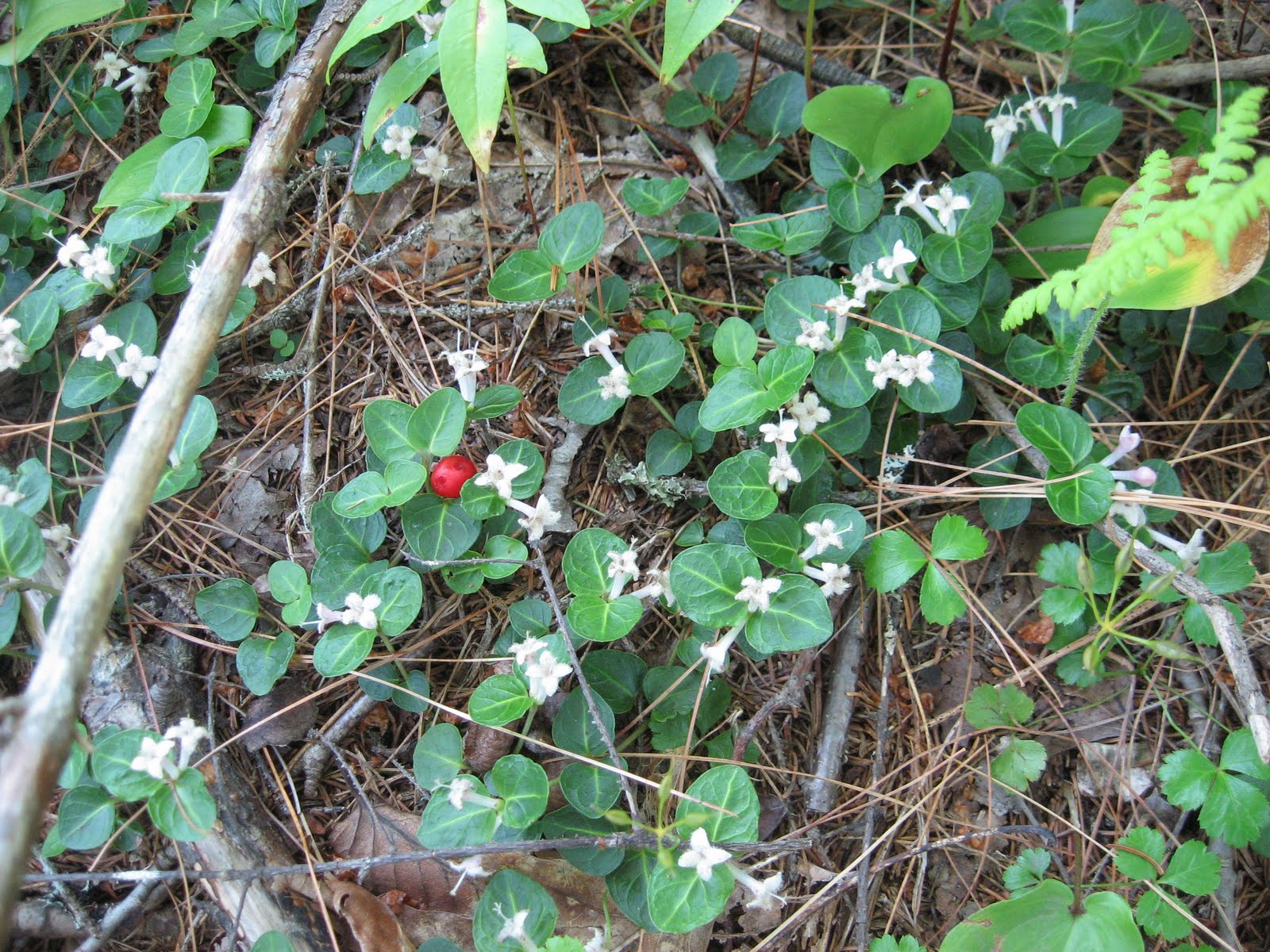
Partridge Berry

Janet writes: Partridge berry, Mitchella repens, has finished blooming here in Mass, but was in full bloom in Maine this past weekend.  As you can see in the photo, the tiny white flowers of this trailing ground cover come in pairs.  The twin flowers fuse, giving rise to only one berry, and the two spots that can be seen on each berry (see the single red berry in this photo) are vestiges of this process.

The berries are food for a variety of birds and mammals.  Humans can eat them, but describe them as bland and seedy.  I have yet to sample them.  It is said that native Americans used the leaves to treat pain during childbirth, hence one of its common names: squaw vine.

Sunday, July 3, 2011

Swamp azalea

Janet writes:  Lately I have been looking closely at plants of all kinds, and noticing how common "hairs" are on various structures: twigs, buds, leaves, stems, and flowers.  These hairs are quite different from those on the skin of most mammals.  More accurately called trichomes, plant hairs have many functions.  They may deter herbivores, guide the path of pollinators, or affect photosynthesis, leaf temperature, or water loss.  Some trichomes have glands which store and secrete chemicals that interact with herbivores or pollinators.

In the photos you see swamp azalea, Rhododendron viscosum, (found at the edge of a pond in Sudbury, MA), the buds of which are equipped with secretory glands on their tips.   If you click on the photo you should be able to see the tiny, rust colored glands on the tips of the "hairs".  I have not been about to find out exactly what their function is, but I am guessing from the species name "viscosum", that they secrete sticky substance which may help deter herbivores.


Monday, June 27, 2011

Tracking Quiz

Can you identify the animal sign in this photo?

Tuesday, June 21, 2011

Hazel, milkweed, and iris

I was thrilled to find an American hazel, Corylus americana, loaded with nuts.  This common understory shrub never seems to have many nuts when growing under the forest canopy, but this one in full sun at the edge of a beaver pond, was packed.  The photo is a close up of a single nut in its involucrum.  I'll be heading back to the swamp come late summer, to see if I can get a few before the squirrels eat them all.

Next is poke milkweed, Asclepias exaltata, a relative of common milkweed.  While the latter seems to do fine in poor soil, the one pictured above needs richer soil, and is said to be somewhat uncommon in MA.  This was growing near the same beaver pond.

Finally, the blue flag, iris versicolor, showing off its beautiful veining in the morning light.

Three wetland arrow heads

Janet writes: I have been spending much time learning about the flora of New England, these days.  Yesterday I identified 3 plants, all with leaves shaped like arrow heads, and all growing in a beaver pond and along its margin. 

I hope the photos appear in the order I intended.  If so, the first is arrowhead, the one with the edible tuber, sometimes called duck potato.  The genus is Sagittaria, named for the arrowhead leaf shape which is known to botanists as sagittate.  The species shown here is, I think, latifolia, the larger leafed of two closely related ones.  The smaller species is Sagittaria cuneata, listed as threatened in Massachusetts.

The second photo is arrow arum, Peltandra virginica, but its plump tubers are said to be toxic, if eaten raw.  The experience of eating them has been likened to swallowing a mouthful of needles.  Kind of makes me wonder how anyone could eat enough of it to get sick.  Some folks claim that cooking it makes it edible, but others say it made them sick even after it was boiled for 20 minutes.  I won't be trying this one any time soon.

Finally, the leaves of pickerelweed, Pontederia cordata, are said to be edible if picked in early summer before they have unfurled, and the nut-like fruit gathered and eaten in late summer.

I found it curious that 3 distinct pond plants all evolved with "sagittate" leaves, a shape rarely seen in uplant plants, so I asked a botanist friend if he had an explanation.  He suggested that the shape allows water to drain off quickly, an advantage if leaves get submerged from time to time, since otherwise sediments could collect on the surface.

Monday, June 20, 2011

The Life of An Urban Coyote

Here's a peek into the life, courtship and hard times of urban coyotes, growing up on the rough side of Chicago. Lars

http://urbancoyoteresearch.com/index.htm