Saturday, June 11, 2011

Otter Behavior

Lars posts an interesting view of the social nature of otters.

http://www.youtube.com/watch?v=n9APqLA2YKs

Thursday, June 9, 2011

Bufo Americanus: Our Humble Toxic Toad


I'm seeing clouds of tadpoles these days in the nearby pond, which prompts me to post a few photos I've taken of the toad life cycle. The start of it all - once the familiar spring trilling of the males has lured in the females - is in the first picture: Amplexus (Latin for "embrace"). The second shot shows the strands of eggs, which take a few days to a couple of weeks to hatch. The third pictures what's going on right now: thousands of tadpoles, which morph over the course of a month or two into toadlets. Those are the most difficult, I think, to capture photographically; they are very active once they leave the water. Though none of these stages are particularly tasty - thanks to their "bufotoxin"-producing glands - there are definitely predators out there, just waiting. Take a look back in the Animal Trackers of New England archives (Apr. 22, 2010) to see one.

Saturday, June 4, 2011

Maple-leaf Viburnum

....is in bloom! Get out in the woods and enjoy them close up!

Phoebe and Freeloader

Janet was snooping around in central MA this morning, and discovered
this nest plastered to the wall of a cliff. This was well of the beaten
path, and the cliff wall faced a large wetland. As you can see, the
outer part of the nest is made of moss and other fibers, and lined with
fine grasses. I believe the nest and white eggs belong to an eastern
phoebe, and the speckled ones were left by a brown-headed cowbird.

Phoebes often build their nests on human made structures: under bridges,
on rafters, trestles, etc. Natural sites like you see here have become
fairly uncommon, according to what I read, so I was excited to find it.

I've also learned that, like this one has been, phoebe nests are heavily
parasitized by brown-headed cowbirds, and the phoebes often dessert the
nest and begin anew, when they discover those big speckled eggs.
However, these eggs were quite warm, so I think someone has been setting
on them. I must have frightened her away without realizing it.

Wednesday, May 25, 2011

Minima maxima sunt

...Or maybe it's parva leves capiunt animas.

Anyway, Tetracis cachexiata on Cypripedium acaule.


Monday, May 23, 2011

Bark and Blossoms

Janet writes: These photos are from a recent family hike up to a
ridgetop black gum swamp in southern Vermont. In the top photo you are
looking at the thick, furrowed bark of a mature black gum (tupelo)
tree. I'm guessing maybe 200 yrs old (?). A younger specimen would not
have such deep furrows. An older specimen (around 400 yrs) might have
smoother bark in this climate, because exposure to snow and freezing and
thawing over the years causes the blocks of bark to fall off. This
tree's diameter is not that large, probably because the conditions on a
New England ridgetop are rather harsh for a black gum, which prefers the
warm swamps of the southeastern US. Yet, it is the dominant tree
species in this high elevation VT swamp. How to explain that?

The wood of black gums is so light weight (partly because they hollow
with age), and brittle, that trees usually loose just their tops when
subject to severe winds, as ridge top trees often are. The tree remains
alive and can sprout, and vigorously sprout they do. Most other trees
have heavier wood, and in an exposed setting like this, will topple and
die when hit by severe wind, because the roots come up out of the ground
as the tree falls. So, in this environment, a black gum has a
competitive advantage over other species.

So how did this southeastern species get to Vermont? It was common in
the northeast during the "Holocene Thermal Maximum" of 5,000-9,000 year
ago, but its range receded southward as the climate cooled, leaving, in
Vermont, only remnant populations on ridgetop swamps where they could
out-compete other species.

Painted trillium graced the humusy, acidic floor of the swamp when we
visited several weeks ago.

Thursday, May 19, 2011

Venison anyone?


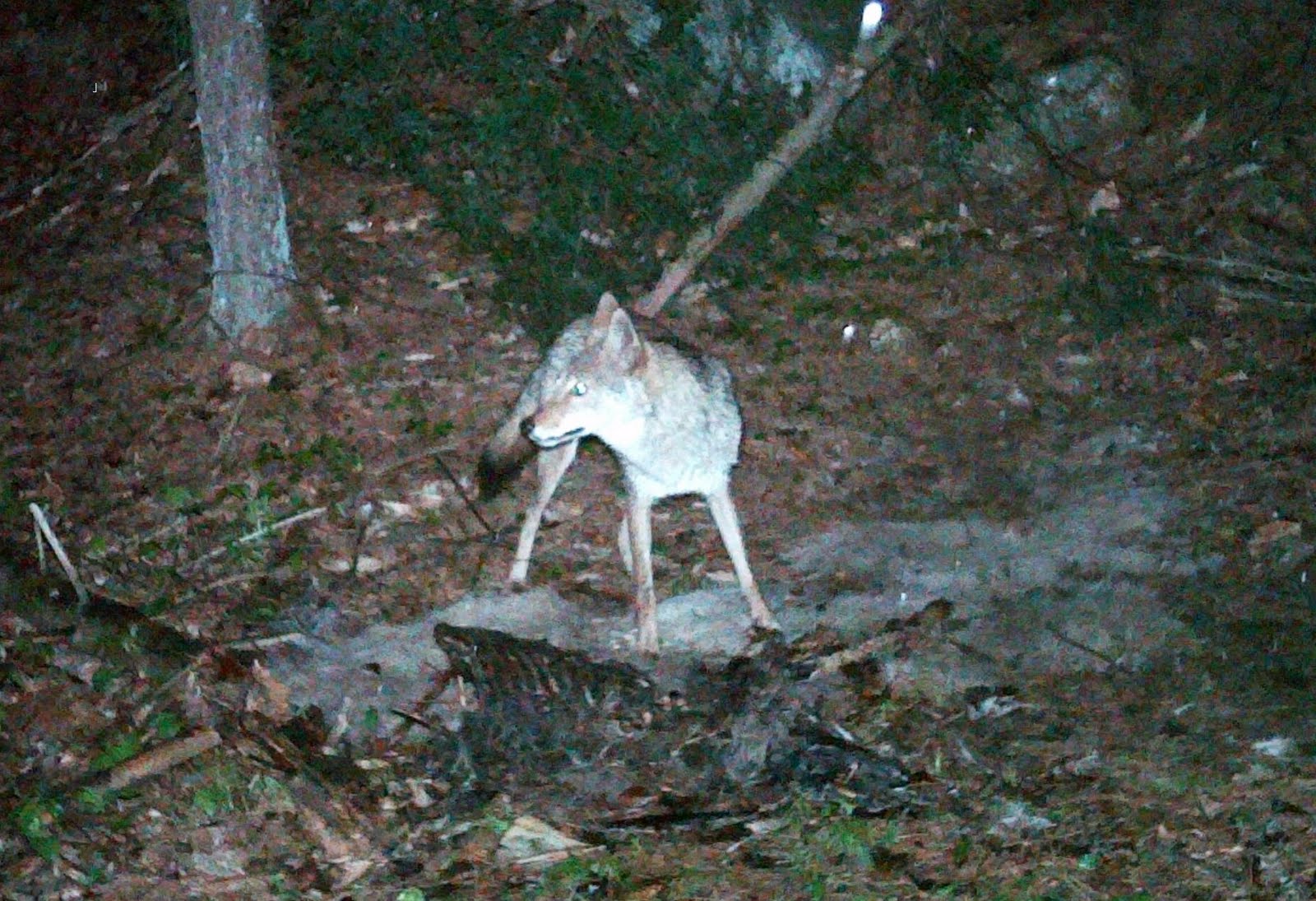
I've had my cameras positioned over a deer carcass for several weeks. For the first half of that time, there was almost no action. Fox, fisher and a hawk came by to take a look, but didn't "dig in." Crows made an attempt, but apparently didn't have the ability to penetrate the hide. It was only after a neighborhood dog finally started working on the very-aged carcass that vultures and, ultimately, coyotes started coming by to snack.